Aviation

Introduction

Pets are an integral part of many families, and for pet owners, their furry friends are like family members. When it comes to air travel, it’s essential to ensure that pets are well taken care of and that their safety is a top priority. Ensuring animal welfare posed a significant challenge for a large North American carrier seeking real-time visibility into animal scanning compliance, from pet acceptance to customer delivery.

That’s where TCG Digital’s Animal Wellness Initiative came in, providing a comprehensive solution that improved the efficiency and effectiveness of the carrier’s cargo operations.

The TCG Digital team’s solution was a game-changer, providing the carrier with real-time visibility of pets from the time they were accepted to customer delivery. The Animal Wellness Initiative included an intelligent dashboard with automated rules for accountability when handling pets, historical reporting for scanning compliance, and revenue impact-handling costs. With rule-based solutions to aid visual checks within and outside scheduled alerts, the carrier could maintain an audit trail of activities and operationalize scanning devices to handle pets during irregular operations.


The solution was cloud-enabled and included an Omni-channel system for alerts and on-demand reporting. By implementing TCG Digital’s solution, the carrier was able to minimize animal transportation incidents and associated handling expenses, all while improving customer satisfaction, making them more likely to choose the airline for future travel.

To implement the Animal Wellness Initiative, TCG Digital utilized mcubeReporting Accelerator Framework, AWS – Lambda, AppSync, Kinesis, DynamoDB, Elasticsearch, Step Functions, CloudWatch, EKS, Docker, Microservice, Java, NodeJS, Ionic, Amplify, Android, iOS, and Angular 7. The consulting engagement allowed for a UX/UI design that detailed functionality and technical architecture/design, ensuring a seamless and efficient implementation process.


Overall, TCG Digital’s Animal Wellness Initiative was a success, providing a comprehensive solution that improved the carrier’s cargo operations, reduced costs, and most importantly, ensured the safety and welfare of pets during air travel.
 

Introduction


Optimizing aircraft turnaround time is a critical task for airlines looking to maximize efficiency and minimize costs. Delays in turnaround time can lead to lost revenue opportunities and increased costs associated with aircraft operations. According to industry estimates, up to 15% efficiency can be achieved in current turnaround processes and technologies.

One of the most significant contributors to turnaround delays is refueling, accounting for a whopping 56% of all such delays. The typical cost for turnaround operations for a B737 is $70/hour. The good news is that a 25% uplift in refueling efficiency can reduce turnaround time (TAT) by up to 3 minutes, which can translate into significant cost savings for airlines. For airlines with a fleet size of around 500 aircraft, reducing cycle time by 4-6 minutes can free up 2-3% of the fleet, potentially leading to cost savings of between $30-75M through TAT optimization.

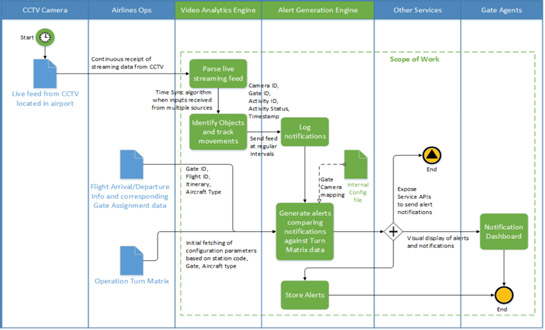
But how can airlines achieve these efficiencies? Our breakthrough solution for TAT Optimization offers significant benefits to both airlines and airports. By reducing the cost of operations and minimizing ground time, our solution enables better aircraft utilization and provides opportunities for airlines to operate on newer routes, ultimately leading to increased revenue opportunities for both airlines and airports. It utilizes real-time feeds from airport cameras at gates, analysing video feeds in real-time through advanced AI/ML algorithms over a scalable cloud platform. The system analyses moveable and immovable objects on the tarmac, such as luggage carts, trolleys, cargo, fuel trucks, tugs, catering trucks, cleaning staff and equipment, and other objects, to determine turn events that could delay TAT. The system also generates pre-configured alerts and notifications to enlisted subscribers. It provides a true Omni channel customer experience via state-of-the-art dashboards.

The solution landscape

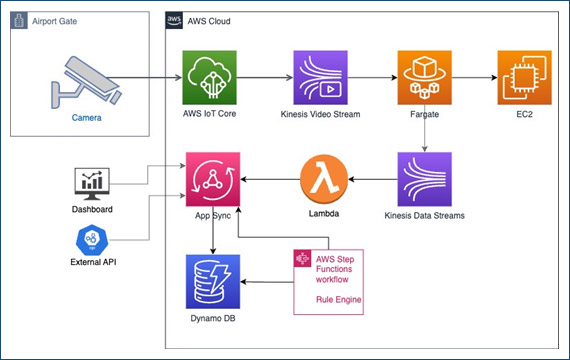
The backbone of TCG Digital’s solution is built on AWS infrastructure. Video feeds from gate cameras at airports are captured using AWS IoT Core and published onto Kinesis Video Stream. The Orchestrator running on ECS Fargate consumes the videos and uses a pre-trained inference model running on an EC2 instance to generate turnaround events. It then publishes those events onto a Kinesis Data Stream. A Lambda function consumes these events and mutates them to an AppSync API to be displayed on the turnaround dashboard. A rules engine built using Step Function analyses the events and raises alerts in case of any potential delays.

In conclusion, TCG Digital’s TAT optimization solution is a game-changer for airlines looking to improve efficiency, reduce costs, and enhance the passenger experience. By reducing turnaround time, airlines can increase revenue opportunities, operate more efficiently, and provide a more seamless travel experience for their passengers.

The solution backbone

How Technology is changing the Aviation Industry

Introduction

Airlines will continue to adapt to the evolving new normal, operate under strict budget constraints, and prioritize cash preservation to tackle the uncertainties and challenges. So, maintaining the aircraft at optimal operation levels is critical to run the airlines.

In spite of being new generation aircraft and having efficient and longer lasting engines, the cost of maintenance continues to increase due to shortage of resources, scarcity of spare parts of older aircrafts, and inflation. As such, airlines are shifting attention towards leveraging the latest innovative technologies, which were not widely available in the recent past, to tackle increasing challenges in maintenance operations. Among these latest cutting-edge innovative technologies, a Digital Twin is playing a critical role in the space of aircraft maintenance.

Digital Twin (DT)

A digital twin refers to a computer-based replica of a tangible entity, system, or operation that exists in the physical world. However, it is more than just 3D models. Digital Twin implements all of the data and models required to accurately represent the different aspects of a product or process to recreate how the product and process will behave in a changing environment in the real world. A critical prerequisite of the digital twin notion is that it must be a dynamic and constantly updated representation of the real product, or process in question.

As per E. Glaessgen and D. Stargel “A Digital Twin is an integrated multiphysics, multiscale, probabilistic simulation of an as-built vehicle or system that uses the best available physical models, sensor updates, fleet history, etc., to mirror the life of its corresponding flying twin”

Aircraft Maintenance and Digital Twin

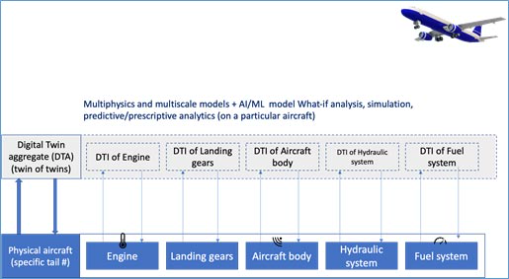
Not all components/parts in an aircraft are good candidates for a digital twin. As the implementation of DT is complex and costly, it is important to focus on parts/processes that are critical to business operations and will provide ROI. An aircraft has multiple components, and so, only a few qualify as candidates for DT e.g., engine, landing gear, hydraulic system, fuel system, and aircraft body.

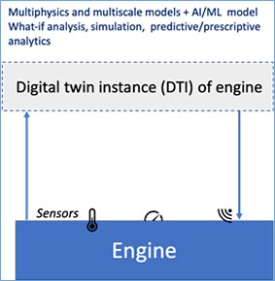
Digital Twin applies multiphysics and multiscale modeling techniques along with AI/ML models, which analyze the behavior of aircraft components in different electrical, thermal, mechanical, magnetic, and chemical conditions. The sensors generate data points and the models perform the what-if analysis, which captures how different components individually and as a whole will behave in different conditions without changing the properties of the physical aircraft components.

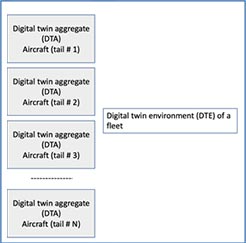
Below is the illustration of the DT of aircraft and fleet:

The Digital Twin Advantage

Transforming maintenance
By collecting data generated by IoT sensors installed in the aircraft parts, digital twins along with AI/ML analytics models can forecast unscheduled maintenance. Additionally, digital twins can also predict the conditions when the parts/components could fail. By providing prior insights into the status of the aircraft components, digital twins facilitate early detection of a problem.

Increased safety
Leveraging digital twins and combining AI/ML-enabled predictive analytics can assist in the earlier detection of a problem by capturing prior insights into the status of the aircraft components. The end result is an improvement in safety, which ultimately makes air travel safer and more reliable.

Lower financial impact
Digital twin enables the operator to predict probable maintenance failures before the breakdowns can occur. It gives lead time to the operator to minimize downtime and increase aircraft utilization and profitability. By replicating the model in Digital Twin, air carriers can forecast maintenance costs.

Improved supply chain
With the application of Digital Twin, operators can manage the inventory more effectively by appropriately ordering the parts that would fail as forecasted by the analytics model.

With advanced technologies like Digital Twin, aircraft maintenance has become even more effective and it is impacting the aviation industry significantly. To learn more about innovative technology in aviation, visit https://aviation.tcgdigital.com/digital-transformation/

References