The chemical industry is facing a paradox.
Organizations have never possessed more scientific data, yet extracting meaningful insight from that data remains remarkably difficult.
Across R&D, manufacturing, laboratory systems, patents, scientific literature, and regulatory repositories, enterprises generate enormous volumes of information every day. But despite years of digital transformation, much of this knowledge still exists in disconnected systems that were never designed to work together.
The result is not simply a data problem; it is a context problem.
Scientists still spend significant time searching for information, reconciling inconsistent terminology, recreating prior experiments, and manually connecting fragmented datasets. According to a Forbes cited industry survey, data scientists spend nearly 60% of their time cleaning and organizing data, with another 19% spent collecting datasets instead of generating insights.
Now, as organizations accelerate investment into generative and autonomous AI systems, a larger issue is emerging:
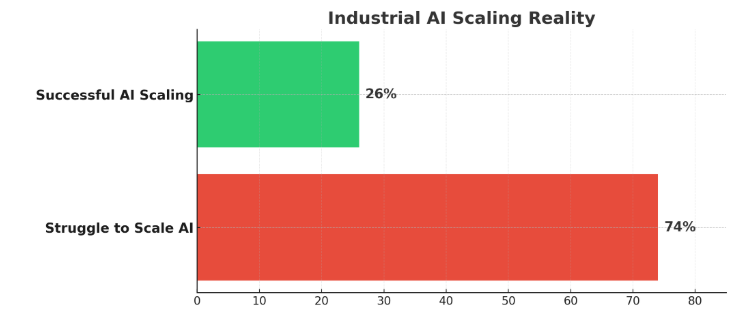
Many organizations are now experiencing what the industry increasingly calls “pilot purgatory” — where AI initiatives succeed in isolated proofs of concept but fail to scale across the enterprise due to fragmented data, lack of semantic context, and disconnected systems.
The Problem Is Not Data Volume — It Is Scientific Context
Most enterprise systems were designed to store information, not to understand relationships between information. But chemistry is inherently contextual.
A polymer formulation’s performance depends on the interaction of polymers, additives, fillers, and processing conditions. Even small changes during R&D can affect manufacturing performance and product quality months later. Scientific insight rarely comes from a single dataset—it emerges from connecting formulations, materials, process parameters, analytical results, and performance outcomes across the product lifecycle.
Traditional enterprise architectures struggle with this reality because data remains fragmented across siloed systems, inconsistent terminology, and disconnected applications. Even simple scientific entities often appear under multiple names or identifiers across systems, making it difficult for AI to recognize whether two datasets describe the same compound or process.
Without context, AI can generate responses, but it cannot reliably reason. And in highly regulated, scientifically intensive industries, that difference matters.
The Rise of Agentic AI in Scientific Enterprises
Semantic intelligence and knowledge graphs are gaining momentum across chemicals and life sciences because AI systems need more than data; they need scientific context.
Instead of treating information as isolated records, semantic systems connect compounds, reactions, experiments, manufacturing outcomes, literature, and workflows into a shared knowledge layer.
Semantic architectures use ontologies and knowledge graphs to establish shared meaning across enterprise systems. That allows AI systems to understand that “vinyl acetate”, “ethenyl acetate” and “acetoxyethene” refer to the same chemical substance, even when different systems; suppliers may describe them differently.
That contextual layer changes how AI operates inside scientific environments. Instead of simply generating responses, AI can connect related experiments, surface hidden relationships, and generate explainable insights grounded in enterprise knowledge.
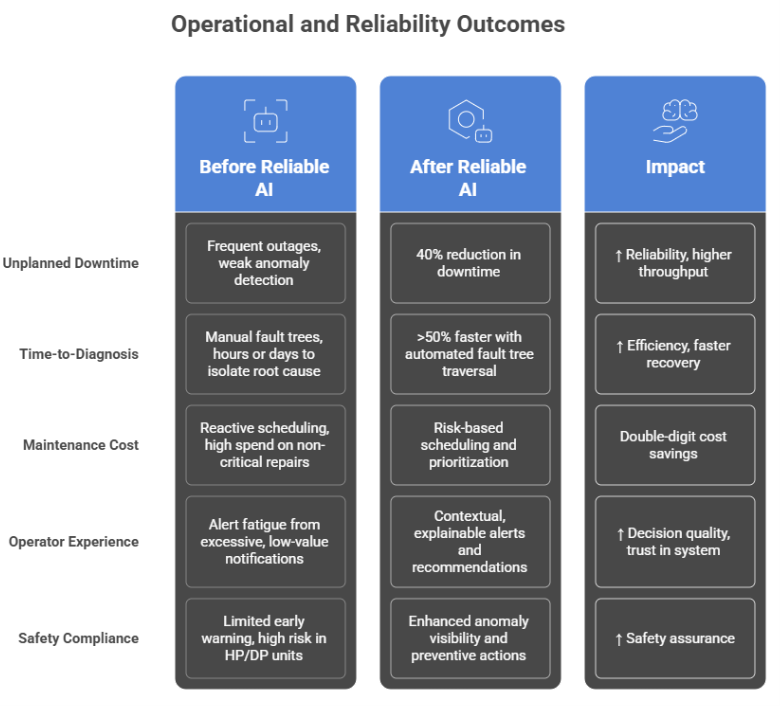
In manufacturing environments, semantic AI systems are already helping accelerate root-cause investigations by connecting process data, quality records, and historical deviations across previously disconnected systems.
As Agentic AI enters scientific workflows, that context becomes even more critical. Because AI cannot reason reliably without understanding scientific meaning.
From Data Repositories to Scientific Memory
The industry is beginning to shift from simply storing scientific data to building institutional scientific memory.
For years, critical knowledge has remained scattered across laboratory notebooks, ELNs, PDFs, spreadsheets, disconnected databases, and the experience of individual scientists. When researchers leave, much of that contextual understanding leaves with them.
Semantic architectures help preserve and connect that knowledge across the enterprise, transforming fragmented data into reusable, traceable, and continuously evolving scientific intelligence.
The impact goes far beyond better search. Organizations can connect upstream and downstream relationships, accelerate root-cause analysis, improve reproducibility, reduce duplicated research, and support more explainable AI systems.
Over time, semantic intelligence may become one of the most valuable forms of enterprise intellectual capital.
The Competitive Landscape Is Changing
The urgency is growing rapidly.
Recent industry research shows that while nearly all life sciences organizations are experimenting with AI, only about 32% have successfully scaled these initiatives beyond pilot programs — and only 5% report significant enterprise value realization.
The companies leading the next wave of innovation will not simply have more AI models. In that environment, semantic intelligence becomes more than a data strategy; it becomes foundational infrastructure for AI-driven science.
Further Reading
For a deeper perspective on scaling AI, semantic architectures, and Agentic AI in regulated scientific environments, explore:
Whitepaper Scaling AI in Life Sciences Manufacturing: The Architecture of Velocity

Author
Angela Bauch
Director Product Management at TCG Digital