Others

Whitepaper Overview

This whitepaper explores how Agentic AI can serve as a powerful infrastructure for intelligence, transforming enterprise operations by bridging the gap between data insight and action. By orchestrating multiple intelligent agents that can reason, predict, and autonomously execute tasks, Agentic AI enables faster decision-making, process automation, and greater operational efficiency. It offers enterprises a way to scale intelligent workflows across functions—whether it’s automating routine tasks, managing complex supply chains, or predicting equipment failures—driving measurable impact on productivity, responsiveness, and innovation.

The Pulse of mcube™

Discover What’s New in mcube™

Discover What’s New in mcube™

July 2025 Edition
An Oil & Gas / Downstream Think Tank on mcube™ : Intelligence, Strategy, and the Future of Profitable Operations

This month’s edition highlights the exclusive conference by Lummus Digital (a TCG Digital & Lummus Technology joint venture) “Infrastructure for Intelligence: Leveraging Gen-AI, LLMs, and Ontologies to Drive Profitability in Indian Oil & Gas,” held on 28 July 2025, Delhi. The event brought together senior policymakers, Oil & Gas PSUs, and process industry leaders to explore how AI/ML is transforming operational performance and decision-making.

Also featured in this edition is a whitepaper on how Agentic AI enables autonomous enterprise operations through coordinated multi-agent systems and integrated intelligence.

This is followed by a pro-tip on how centralizing design elements in mcube™ ezeXtend’s App Settings accelerates application development and ensures cohesive, brand-aligned user experiences.

Andreas Diggelmann
Chief Product Officer, TCG Digital

Conference Spotlight : Infrastructure for Intelligence in Indian Oil & Gas on the foundation of mcube™

The exclusive conference by Lummus Digital (a TCG Digital & Lummus Technology joint venture): “Infrastructure for Intelligence: Leveraging Gen-AI, LLMs, and Ontologies to Drive Profitability in Indian Oil & Gas,” was held on 28 July 2025 at The Oberoi, Delhi.


The conference brought together senior leadership from Indian Oil Corporation Limited (IOCL), Bharat Petroleum Corporation Limited (BPCL), Hindustan Petroleum Corporation Limited (HPCL), Centre for High Technology (CHT), Engineers India Limited (EIL), Haldia Petrochemicals Limited, and Reliance Industries to explore how Gen-AI and ontology-driven intelligence are reshaping the future of the Indian oil & gas sector.


Opening sessions by the chairpersons of IOCL, BPCL, and HPCL set the tone for an engaging evening focused on accelerating digital adoption. A special highlight was the Chairman’s Panel chaired by Shri Tarun Kapoor, Advisor, The Hon’ble Prime Minister’s Office, which offered a forward-looking view on AI’s role in shaping the sector’s future.


A spotlight session on mcube™ showcased how AI/ML-powered solutions are advancing enterprise intelligence—enhancing reliability, streamlining processes, and boosting supply chain efficiency across the oil & gas value chain.

White Paper: Agentic AI in the Enterprise: Infrastructure for Intelligence using mcube™ by TCG Digital

Agentic AI is transforming enterprise operations by enabling intelligent agents to analyze data and autonomously execute complex tasks. Built on a master–sub-agent framework, it allows seamless coordination across specialized functions like querying data, generating insights, and automating workflows. mcube™ powers this with LLM’s Knowledge Graphs, Ontologies, and Hybrid RAG for accurate, context-aware output. Key components like the Agent Development Kit (ADK), Agent-to-Agent Protocol (A2A), and Model Context Protocol (MCP) support rapid deployment and secure integration. Real-world applications include automated data creation, regulatory compliance, faster R&D, and improved plant reliability, turning enterprise intelligence into real-time, autonomous action.

Read the whitepaper to know more.

Pro Tip: Accelerate Application Development with Centralized Visual Cohesion: mcube™ ezeXtend's App Settings

The App Settings feature in mcube™ ezeXtend is a powerful feature marketing differentiator that directly addresses common pain points in application development; it leverages the platform’s low-code capabilities to deliver visual consistency and accelerated time-to-value. App Settings allow organizations to establish and enforce a unified visual style across all their analytical and data capture applications with unprecedented efficiency. This eliminates the need for redundant, element-by-element design modifications, ensuring rapid deployment of professional, on-brand interfaces. Available in the ellipses option of ezeXtend, this feature centralizes styling parameters such as colour palettes, font families, component spacing, and border treatments. By setting these attributes at a global level, all elements within a screen automatically inherit these defined styles. This adheres to design system principles, ensuring consistency.  It transforms the design process from a granular, time-consuming task into a centralized, agile, and visually cohesive operation.

Resources & Support

Explore more about how our customers have used mcube™ to transform their businesses.
Stay tuned for next month’s edition where we explore more powerful features and customer stories. Until then, keep leveraging the power of AI with mcube™!
The Pulse of mcube™

Discover What’s New in mcube™

June 2025 Edition
AI-Powered Football Intelligence — mcube™ at the DFB-Pokal Finals 2025

In this special edition on mcube™ in sports, we look at how it’s changing the game—literally—by redefining football through data-driven intelligence and predictive precision.


The DFB-Pokal Final 2025 on 25th May in Berlin became a live showcase of AI’s impact on football. mcube™ demonstrated how smart data can predict outcomes with precision—ushering in a new era of AI-Powered Football Intelligence.


Coming up, a detailed case study showcasing how mcube™ redefined the DFB-Pokal Final 2025, along with expert insights into the transformative role of AI in modern football. This is followed by a focused Pro-Tip on Inter-App Communication, highlighting how SemantX is enabling seamless and intelligent system integration.

Andreas Diggelmann
Chief Product Officer, TCG Digital

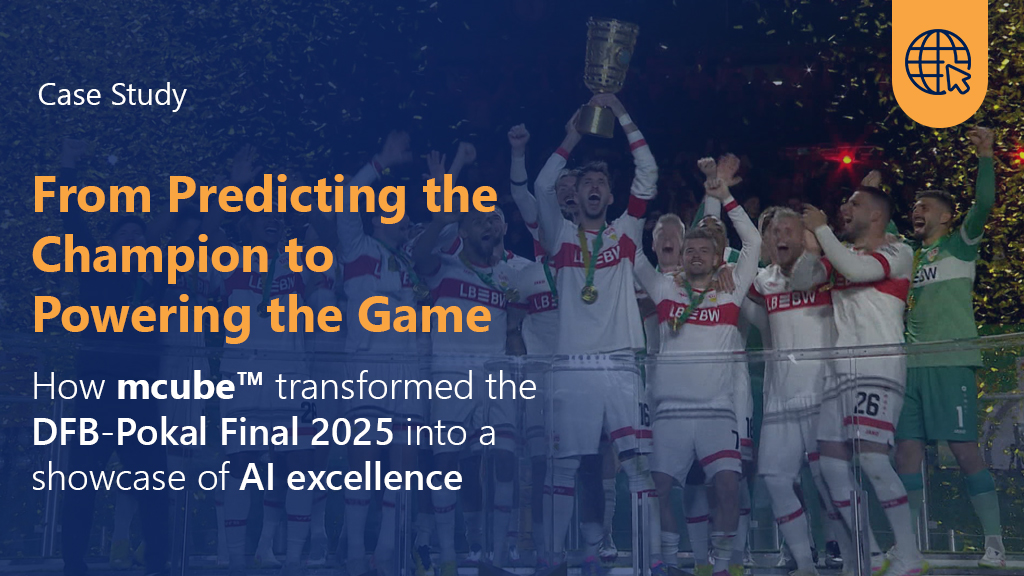
Case Study: From Predicting the Champion to Powering the Game: How mcube™ transformed the DFB-Pokal Final 2025 into a showcase of AI excellence

 At the heart of the 2025 DFB-Pokal Final, we took on a bold challenge: Could AI do more than just report the game? Could it predict, curate, narrate, and distribute it in real time, across borders and languages? mcube’s AI-Powered Matchday Framework forecasted a 3–2 win for VfB Stuttgart over Arminia Bielefeld (vs. actual 4–2 result) with 76.43% confidence, drawing on a model trained on 10+ years of data. Additionally, mcube™ localized content in 11 languages, curated key moments every 10 minutes using sentiment and gameplay analysis, and automated delivery across TV, OTT, and social media—showing AI can drive the full lifecycle of a live sporting event.

DFB, The German Football Association and TCG Digital bring AI to football

“There’s a great intersection between professional sports and technology,” says Kay Dammholz, Director, DFB GmbH & Co, on partnering with TCG Digital and its AI platform mcube™. From player scouting with neuroscience and data to automated commentary and match reports, AI is helping “make the sport itself better.”

DFB shared feeds from the DFB-Pokal Final and Women’s Bundesliga matches, with TCG Digital managing flawless delivery and integration. “All the stats, revenue sharing, and sponsorship—everything tech can offer—we’re testing together,” Kay adds.

Watch the full video here

Brain2Kick : How Neuro-AI Is Revolutionizing Sports Intelligence with mcube™

“The brain drives every on-field decision,” says Dr. Angela Bauch, Director of Product Management, TCG Digital, highlighting how mcube-Nicara is embedding neuroscience into the core of sports intelligence.


“With mcube-Nicara, we can map brain’s connectivity, apply AI to imaging data, and benchmark young talent against elite athletes,” she explains. These insights help predict performance, assess injury risk, and uncover undervalued players— “adding the missing dimension to modern sports intelligence.”


By integrating brain, physical, and psychological metrics on one unified platform, mcube™ is revolutionizing how teams scout, train, and optimize for peak performance.


Watch the full video here

Pro Tip: Inter-app communication enabled by SemantX

One of the standout features of mcube™ is the seamless integration of semantic data across applications through powerful APIs enabled by SemantX. These APIs unlock the true potential of interconnected intelligence—allowing data modelled semantically to flow effortlessly between applications. Whether it’s driving ML and Gen-AI models with enriched context or powering custom-built apps and visualizations, this capability transforms complex use cases into streamlined solutions. With this cross-application synergy, you can build smarter, faster, and more scalable innovations—backed by the strength of a unified semantic backbone. For instance, in the field of sports intelligence, this integrated system is being used to retrieve data from diverse sources (e.g., athlete performance, medical records, training data) to reveal hidden relationships and enable data-driven decision-making for optimizing performance, injury prevention, and strategic planning.

Resources & Support

Explore more about how our customers have used mcube™ to transform their businesses.
Stay tuned for next month’s edition where we explore more powerful features and customer stories. Until then, keep leveraging the power of AI with mcube™!
The Pulse of mcube™

Discover What’s New in mcube™

May 2025 Edition
AI Agents and Ontologies in Lab Innovation
This month marked a major milestone with CTEC 2025, where mcube™ took center stage – the focus was clear: we’re moving beyond traditional machine learning toward Agentic AI—where intelligent systems understand context, infer intent, and act autonomously on diverse data.

Whether it’s ingesting lab notes in biotech R&D or coordinating real-time responses in manufacturing environments, mcube™ AI agents are already delivering impact—decoding complexity, predicting outcomes, and enabling decisions that are explainable and traceable.

In this issue, we recap our CTEC spotlight sessions on Agentic applications, and introduce a powerful feature in MorpheX that gives ETL developers real-time control over data flows.
Andreas Diggelmann
Chief Product Officer, TCG Digital

Spotlight: AI Agents for the Lab: Powered by Ontologies and Generative AI

Agentic AI isn’t aspirational—it’s already operational with mcube™. Across sectors, from labs to factory floors, specialized AI agents interpret, connect, and act on diverse data. mcube™ fuses generative AI with deterministic knowledge graphs to power decisions that are accurate, explainable, and traceable. In R&D, agents parse everything from structured records to handwritten notes, updating systems or aligning protocols with regulations. While in manufacturing, our agents integrate live sensor feeds, historical logs, and SOPs to predict issues, prescribe actions, and coordinate real-time response. This is AI that works—with insight, context, and accountability.

Watch the video from our session at CTEC 2025 to see how mcube™ is powering Agentic AI applications for Labs on the foundation of Ontologies and Generative AI

Industry Insights: Gen-AI for Master Data Creation in LIMS

Reimagine Master Data with AI-Driven Precision

Creating and maintaining master data has traditionally been a slow, error-prone process—but not anymore. With mcube™, AI transforms how organizations handle structured and unstructured inputs. Using multimodal LLMs and GenAI, mcube™ auto-extracts, categorizes, and validates key data—be it products, instruments, or methods—before seamlessly uploading it into your information systems. The result? Up to 10x faster data onboarding, 98% rework reduction, and full traceability. Whether in labs, manufacturing, or enterprise ops, this is MDM that scales with intelligence.

Watch this demonstration.

Pro Tip: Empowering ETL Developers with Dynamic Resource Allocation in MorpheX

One of the standout features of the MorpheX application is its intuitive resource allotment configuration panel, accessible directly from the front end. This powerful capability empowers ETL developers to optimize performance and cost-efficiency by scaling resources up or down based on workload demands, without needing backend intervention.

Whether you’re running lightweight transformations or executing heavy-duty data pipelines, MorpheX allows you to allocate CPU and memory resources on-the-fly to suit the processing intensity. This dynamic resource control ensures that ETL jobs are executed efficiently, reducing processing time during peak loads and conserving infrastructure during lighter workloads.

The front-end configurability not only enhances usability but also eliminates operational bottlenecks, enabling teams to be agile, autonomous, and performance focused. In an era where flexibility and responsiveness define success, MorpheX puts the power back in the hands of developers.

Resources & Support

Explore more about how our customers have used mcube™ to transform their businesses.
Stay tuned for next month’s edition where we explore more powerful features and customer stories. Until then, keep leveraging the power of AI with mcube™!
Automatic load distribution and load control for steel producer, Netherlands

80%

Reduction in Venting

5%

Energy saving

Significant

Reduction of Operator Workload

Annual cost savings

Business Challenge​

The plant operators were facing  plant insufficiencies such as 10% product blow off (average), inefficient load distribution across five production plants creating high production cost. Furthermore, fast demand changes in the complex network created stress at plant operators and frequent start/stop of plants and compressors increased risk and reduced asset lifetime.

Solutions Deployed

Real-time Optimizer (RTO)
  • Production continuously optimized by RTO
  • Gas network optimization controlling load of three O2 production plants (ASU) in real-time
  • Elimination of venting, optimized efficiency and improved reliability

Benefits

  • 80% reduction in venting , significantly increasing plant efficiency.
  • 5% energy saving, significantly improving the CO2 footprint of plants.
  • Significant reduction of operator workload, effectively reducing stress and improving wellbeing of plant operators.
These improvements collectively delivered an annual savings of 1M USD.

Advanced Automation for
Leading Semiconductor Fab, Oregon US​

40%

Reduction in power consumption

30%

Reduction of GAN blow off

25%

Reduction in
Plant start-up time 

Annual cost savings

Business Challenge

Operators struggled to consistently achieve ultra-high purity levels (10 ppb) required for semiconductor-grade products. Due to concerns over potential purity loss, they were reluctant to adjust ASU loads, especially during fluctuating demand. This led to frequent product venting and yield loss, as manual control lacked the precision and confidence needed for real-time optimization


Solutions Deployed

Automatic Sequence Transition

  • Automatic “one-button” ASU start-up from cold condition
  • Automatic transition between single & dual main air compressor mode

Linear Model Predictive Control

  • Optimization of efficiency & change plant load

Benefits

  • 40% reduction in power consumption, significantly lowering operational costs.
  • 30% decrease in GAN blow-off, enhancing product yield and process efficiency.
  • 25% faster Plant start-up,  improving responsiveness.
These improvements collectively delivered an annual savings of $2.5M USD.

Whitepaper Overview

Discover how Recon-X overcomes the limitations of legacy systems by transforming reconciliation into a data-centric, intelligent process. With built-in automation, seamless integration, and scalable architecture, Recon-X delivers faster, smarter, and more cost-effective outcomes for modern enterprises.

The Pulse of mcubeTM
Discover What’s New in mcubeTM
Apr 2025 Edition
Set the Stage for Autonomous Intelligence with mcube 5.2

This month was all about the launch of mcube 5.2—a bold step forward in enabling autonomous intelligence for enterprises. Streamed live on LinkedIn, the event showcased how the latest release will power decision intelligence, operational autonomy, and domain-contextual AI across the enterprise. The advanced AI orchestration layer of mcube 5.2 enables systems to reason, adapt, and act autonomously. From semantic modeling to seamless data integration, enterprises like Linde are driving real outcomes through intelligent automation.

The discussion was around key capabilities that are set to shape the future of intelligent operations and scale AI-driven impact with greater confidence.

Here’s a quick snapshot of what we covered:
  • Agentic AI
  • Autonomous Plants
  • Ontologies & Semantics
  • Cloud-Native Data Integration
In the sections that follow, we’ll take a closer look at each of the capabilities discussed during the launch.
Andreas Diggelmann
Chief Product Officer, TCG Digital

Spotlight: Key Capabilities of mcube 5.2

Enabling Linde’s Autonomous Plants, Driving EBIT Growth

Global tariffs, volatile input costs, and shifting demand dynamics are squeezing margins, putting intense pressure on process manufacturers to deliver stronger EBIT. It’s no longer just about driving efficiency—it’s about creating self-optimizing operations. Linde is driving the shift toward autonomous, self-optimizing operations with real-time, AI-enabled closed-loop automation—powered by mcube 5.2 from TCG Digital.

This intelligent system empowers plants to self-optimize—continuously adapting and aligning operations to maximize EBIT.

Advanced Agentic AI: Multi-Agent Collaboration, Goal-Driven Workflows, Strong Compliance

mcube 5.2 advances Agentic AI with plug-and-play, LLM integration, enhanced AI orchestration for multi-agent collaboration, and context-aware decision-making using ontologies. Within mcube, AI agents take on specialized roles—some retrieve and analyze data, others generate insights or execute actions. These agents collaborate dynamically, adapting their decisions in real time based on evolving data and business context.

mcube enables flexible, goal-driven workflows, where multiple models handle specific tasks like anomaly detection or report generation. Strong governance and compliance features ensure that these intelligent agent workflows remain secure, transparent, and enterprise-ready.

Ontologies and Semantics for Intelligent, Adaptive Workflows

mcube 5.2 leverages advanced semantic technologies—because it’s how we go from standard automation to truly intelligent, adaptive workflows that drive real business value. This ensures explainable, auditable decisions—critical for regulated industries—and provides transparency, scalability, and flexibility, adapting seamlessly to new data, compliance rules, and evolving business needs.

Cloud-Native Data Integration for Accurate, Low-Latency, Adaptive AI

mcube 5.2 seamlessly integrates data, contextualization, and AI to enhance enterprise AI capabilities. Its cloud-native architecture supports no-code data engineering, real-time event data integration, and scalable resource management. This ensures AI agents receive accurate, low-latency data to make autonomous decisions and adapt to changing conditions.

Pro Tip: Enhancing Data Governance with Granular Access Control

mcube offers precise data-level authorization, enabling organizations to go beyond basic roles and implement highly granular control over data access at the dataset level. This includes the ability to define column-level security by selecting which fields are visible and row-level security by setting conditions to filter data. By implementing these fine-grained controls, organizations can ensure that different teams and users have a customized and secure view of the data they need, fostering secure collaboration and maintaining data privacy. This advanced approach allows for tailoring data access to specific requirements, enhancing overall data governance.

Resources & Support

Explore more about how our customers have used mcube™ to transform their businesses.
Stay tuned for next month’s edition where we explore more powerful features and customer stories. Until then, keep leveraging the power of AI with mcube™!

In the era of big data, advanced analytics, and AI, the need for efficient data management systems becomes critical. Traditional data warehousing and data lake architectures have their limitations, particularly in navigating through diverse and voluminous datasets, making it extremely difficult for users to get to relevant, contextualized data. Traditional data architectures suffer from these problems:

The need for a holistic approach

Data Accessibility

Running analytical queries on large and diverse datasets is challenging, and it becomes extremely difficult for users to find and get contextualized data out. This also means that the existing architecture can only provide limited support for advanced analytics and AI as these algorithms need to process large datasets using complex querying.

Collaboration Bottlenecks

Lack of a shared, unified, and contextual data view causes challenges for team collaboration across the organization, often leading to redundant data acquisition and data management activities. In most cases, the data does not adhere to the FAIR (acronym for Findable, Accessible, Interoperable, and Reusable) principles, and hence, does not allow users to exploit the full potential of the data.

Data Integrity Issues

Keeping the data lake and data warehouse consistent is difficult and costly because of redundancies. Lack of a semantic layer impacts analysis integrity.

The concept of a data lakehouse, which integrates the best features of both data lakes and data warehouses and adds a semantic layer for contextualization, emerges as a compelling solution.

A data lakehouse is an open data management architecture that combines the flexibility, cost-efficiency, and scale of data lakes with the data management capabilities of data warehouses. It enables dashboarding, traditional AI, generative AI, and AI-based applications on accessible and transparent data.

Unpacking the Data Lakehouse Advantage:

The following are the core components of a holistic data lakehouse strategy. The technology helps elevate the data strategy of organizations and accelerates velocity to value across the value chain:

Data Ingestion (Easy to Get Data In)

The data lakehouse makes it “easy to get data in”, coming with pre-built standard connectors to various systems and instruments, supporting both real-time and batch ingestion, and providing features for data transformations at various stages. The overlay of a semantic layer enables data ingestion processes to utilize the semantic definitions. Knowledge graphs can integrate data from various sources, including structured, semi-structured, and unstructured data, and help create a cohesive representation of information stored in the lakehouse.

Data Leverage (Easy to Get Data Out)

The data lakehouse comes with robust data management features. The business metadata management is powered by knowledge graphs, providing ontology management and knowledge modeling capabilities. It adheres to the FAIR principles (i.e., makes data Findable, Accessible, Interoperable, and Reusable), thus making it “easy to get data out”.
  • By defining semantic relationships and hierarchies between data entities, knowledge graphs provide rich domain context that enhances data understanding and usability. This allows users to navigate through data based on relationships rather than just rely on raw data of technical data dictionaries.
  • Connecting the Semantic Layer to the Analysis layer allows the use of contextualized semantic business terms for analytics. It enables efficient querying of data in natural language and provides contextual responses that are easy to use, understand, and interpret.
  • Knowledge graphs can enrich data by linking it with external datasets or ontologies, providing additional context that can improve analysis and insights.

Creating a powerful Data Lakehouse with mcube™

This reference architecture attempts a comprehensive and complete view of all possible components that can contribute to a Data Lakehouse implementation. Depending on the scope, type of data, and the analytical processes that need to be supported, your mileage might vary in terms of functionality and required elements.

Reference Architecture for the Data Lakehouse

This reference architecture attempts a comprehensive and complete view of all possible components that can contribute to a Data Lakehouse implementation. Depending on the scope, type of data, and the analytical processes that need to be supported, your mileage might vary in terms of functionality and required elements.

Reference Architecture:

Leveraging our end-to-end AI platform, mcube, organizations can create robust data lakehouses, with the aim to streamline data management by integrating various data processing and analytics needs into one architecture. This approach helps avoid redundancies and inconsistencies in data, accelerates analysis throughput, and minimizes costs.

The platform mcubeprovides advanced analytics/AI capabilities and data management on the same platform managed by common platform services. This makes it an extremely powerful platform for implementing the lakehouse and deploying analytical and AI applications on top of the lakehouse.

A data lakehouse is an open data management architecture that combines the flexibility, cost-efficiency, and scale of data lakes with the data management capabilities of data warehouses. It enables dashboarding, traditional AI, generative AI and AI-based applications on accessible and transparent data. By bridging the gap between data lakes and data warehouses, the data lakehouse architecture provides users with the tools necessary for efficient data accessibility, collaboration, and integrity. As the various user communities continue to generate vast amounts of data, the adoption of data lakehouses will likely play a pivotal role in advancing innovation.

The need for a holistic approach

Establishing a data lakehouse is not a value proposition on its own. It is the analytical processes and applications that it supports that determine the actual value impact to the organization. It is, therefore, crucial to keep use cases and business processes that need to be optimized in mind when starting the build-out of a data lakehouse.

Data need to be organized in fit-for-purpose data structures to balance cost and performance. Refresh cycles, real- or right-time requirements determine the approach to ingestion processes, and the analytical/AI-based result delivery processes to humans and other applications drive the approach to integration.

Only a holistic approach and a technology platform, which allows for the required flexibility and integrated approach between the data lakehouse and the AI/analytics based processes and applications, can provide the speed and agility to minimize time to value.

Creating a powerful data lakehouse with mcube™

Leveraging our end-to-end AI platform, mcube™, organizations can create robust data lakehouses, with the aim to streamline data management by integrating various data processing and analytics needs into one architecture. This approach helps avoid redundancies and inconsistencies in data, accelerates analysis throughput, and minimizes costs.

The platform mcube™ comes with mcube.data and mcube.ai, thus providing advanced analytics and AI capabilities and data management on the same platform managed by common platform services. This makes it an extremely powerful platform for implementing the lakehouse and deploying analytical and AI applications on top of the lakehouse.

The holistic impact of mcube™

As end-to-end data and AI/GenAI platform, mcube™ is designed to conquer the ever changing needs of organizations that are embarking on the journey of their digital transformation. The functional components within mcube.data and mcube.ai cover the breadth of capabilities needed for accelerated deployment cycles of traditional AI and generative AI-driven applications and business processes. The underlying platform services allow for enterprise-class management, monitoring, and compliance.

The data lakehouse solution powered by mcube™ provides users with the tools necessary for efficient data accessibility, collaboration, and integrity. It provides a technology platform that allows for the required flexibility and integrated approach between the data lakehouse the AI/analytics-based processes and applications. This approach provides agility that maximizes velocity to value for the business.