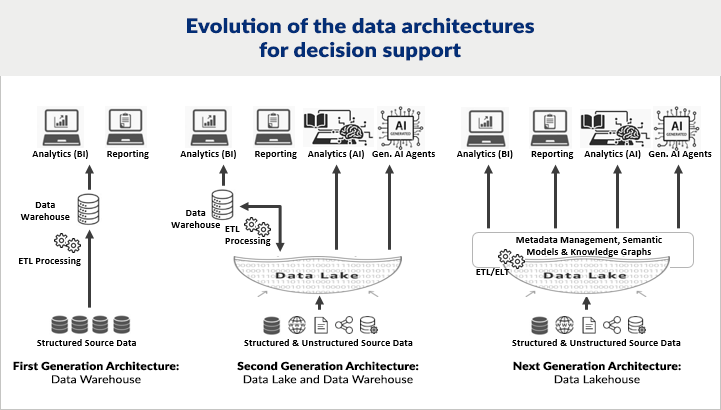
Most IT and business leaders are traversing the maturity path of leveraging data to its fullest potential, and in that process they have envisioned a fully automated and governed data platform for their enterprise —one that provides a single version of the truth, is scalable, seamlessly integrates with existing infrastructure, and builds a strong foundation for AI capabilities on top.
Yet, the reality is far from this vision. Wondering Why?
- You have 5-8 tools that you are managing for different data types and sources, with many vendors to manage.
- This fragmentation is costly, not only in terms of licensing and system integration but also in the effort and time required to make these tools work together.
- Some of your proprietary data is still stored in legacy systems, which are not interoperable.
- Your data lake initiatives, which were meant to solve these issues, often balloon into high-cost, year-long initiatives without delivering the promised agility.
- Your business leaders want advanced AI capabilities for process transformation, while the data layer is still not in shape to support that.
So what does it take to simplify this complexity?
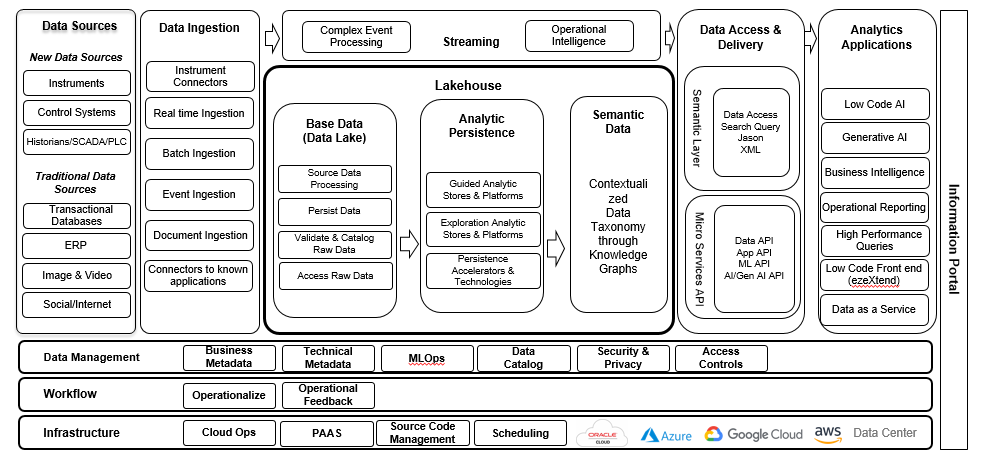
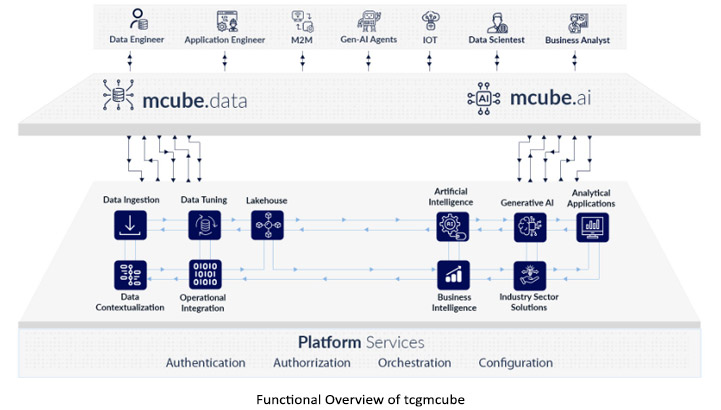
A unified data and AI platform with end-to-end functionality to ingest, integrate, analyze, model, and report on data providing full transparency with regards to process and semantic context (knowledge graphs). One that is modular and highly interoperable, providing investment protection for existing systems and assets through loose coupling and micro-services architecture.
mcube™: Customized Solutions for Industry-Specific Challenges
mcube™, TCG Digital’s flagship enterprise AI and analytics platform, offers a single, unified data and AI platform that delivers what enterprises truly need—a governed, scalable, and simplified approach to managing data and analytical applications. With mcube™, you eliminate the costly, tedious process of piecing together fragmented tools. Today, mcube™ has 75+ active customers across industries like Life Sciences, Oil & Gas, Process Manufacturing, Retail and Insurance. Read about how mcube™ empowered ADMA Biologics with manufacturing excellence leading to an increase in market capitalization With the successful launch of mcube™ 5.1, this latest version builds on the achievements of its predecessors and continues to push boundaries – from advanced AI capabilities, enhanced semantic search for deeper data contextualization and intuitive insights, robust data operations, to low/no-code BI and analytical application modules empowering even business users to create, manage, and deploy AI workflows. mcube™ 5.1 is designed to make your enterprise smarter and more agile.
Unleashing mcube™ 5.1 – Precision Meets Performance!
The most iconic feature expansion has been integrating ‘Semantic Discovery’ that integrates AI, ontologies, and semantic modeling for deeper data contextualization and reasoning for that uber-intuitive and hyper-precision experience. This helps our clients build their own Semantic Discovery Platform for querying, reporting, and exploration and convert any volume or type of unstructured data into actionable knowledge. The semantic search functionality stands on the following pillars:
- Knowledge Graph Inference Combined with Generative AI and RAG (retrieval augmented generation)
- Ontology-Driven AI Search
- FAIRification of Data: supports the FAIR principles (Findable, Accessible, Interoperable, Reusable) for data management.
AI 2.0 “The Heart”
AI2.0 “The Heart” is the driving force behind mcube™ 5.1, infusing the platform with advanced capabilities and setting new standards for how AI is applied across industries. What have we bolstered?
- We are solving the most complex and toughest business problems with cutting-edge ML algorithms and dynamic deep learning frameworks including advanced Gen-AI, NLP, and Computer Vision technologies with the capability for stacked ensemble models to improve predictive performance.
- Robust MLOps – to move AI from PoC to large-scale production, ensuring fast value realization. We have moved ML models into production for some of our clients in a TAT of less than a month. We are streamlining the entire lifecycle of machine learning models for you —from development to deployment and ongoing monitoring.
- Continuous model drift and data drift monitoring and management.
- Auto-ML for accelerating ML model development.
Bolstered Data Ops:
One of mcube™’s strengths is its ability to ingest and integrate data from a wide range of sources. The platform supports both structured (Lakes/Data Warehouse/flat files/Databases) and unstructured data (video, images, logs, key-value, files), providing a comprehensive data management solution that consolidates information from various systems into a unified view. Supporting batch ingest with rapid integration of data sources with complex transformations, also supporting real-time/streaming data ingest from multiple IoT, and streaming sources and transforming data on-the-fly.
Business Intelligence
Data & AI models mean nothing if they cannot be represented as clear, visually intuitive insights, that uncover patterns not previously seen or exceptions you overlooked that might be groundbreaking. Like they say the devil lies in the details, our intuitive visualization puts the spotlight on that little detail that helps you make your strategic decisions with confidence
- Data analysis by employing statistical methods to uncover patterns, trends, and exceptions within datasets and across datasets.
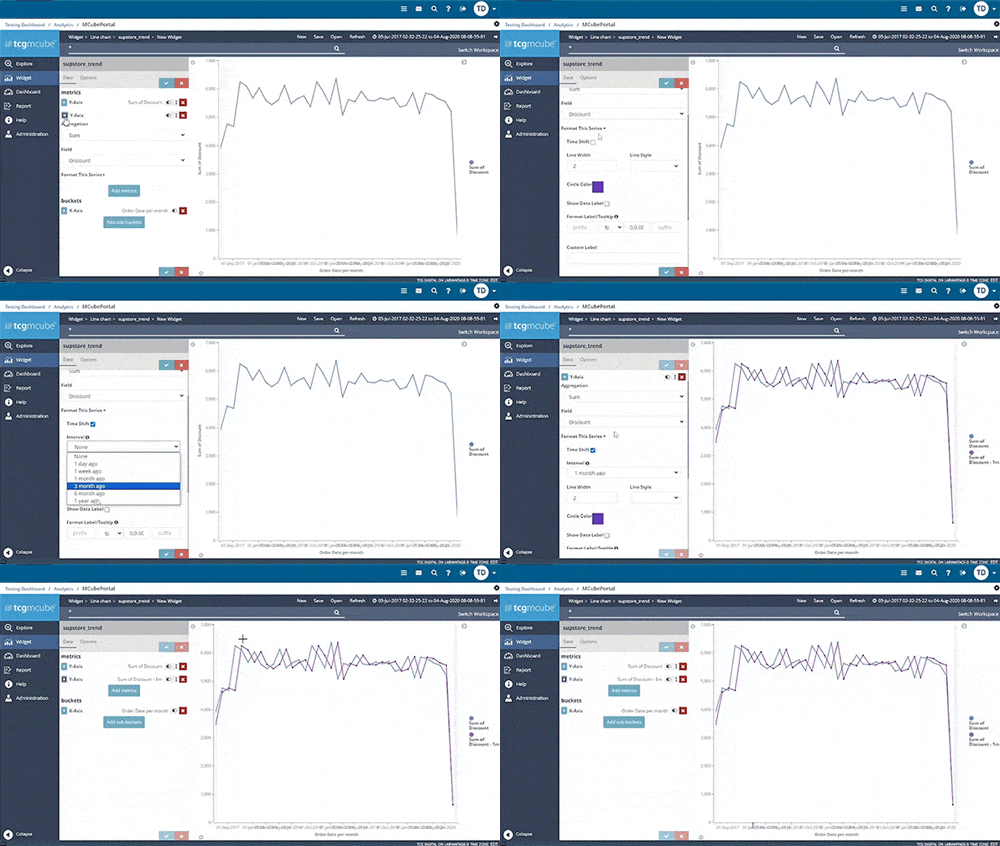
- Data visualization done by means of an extensive library of charts, graphs, and self-service dashboards for easy comprehension of data.
- Reporting done by delivering regularly scheduled or on-demand summaries of key findings and performance metrics. Operational reporting for internal and external compliance and regulatory requirements.
- Performance management achieved by using data-based insights to guide business decisions and enhance outcomes.
ezeXtend: Low-code configuration for analytical applications
With the low-code configuration capability, you can easily tailor web interfaces for data capture, updates, and presentations, eliminating the need for heavy coding. Now, truly ‘democratize’ Data & AI usage for your organization making it more accessible for business users or IT teams to quickly develop bespoke interfaces without relying heavily on extensive development resources:
- Low-Code configuration of web interface screens for data capture / write-back / bespoke presentation
- Interfaces that can fetch/query data from Data Lake / Mart
- Interfaces that interact with AI models and process flows
- Allow user annotation and update and write back to Data Lake / Mart.
- Drag and drop to include various edit controls and graphical widgets in constructing new web screens.
- Create simple workflows involving data annotation and edits/ corrections/ incremental additions
Genie: The Microservices framework that simplifies complex data operations
- Built to enable the reuse of complex processes and functions and to integrate and leverage existing external applications within the mcube™ product family
- The framework provides common protocols for building, embedding, and registering business logic, processes, and functions within mcube™
- Supports license-based access and authentication
- Enables on-demand, scalable orchestration and execution of services
Security and Compliance: mcube™ prioritizes security and compliance with robust measures to protect sensitive information, including end-to-end encryption, role-based access control, and comprehensive audit trails. The platform adheres to the highest standards of security and regulatory compliance like FEDRAMP. These features ensure data integrity and privacy, making mcube™ a reliable choice for organizations that must comply with strict data governance policies.
Looking Ahead!
Stay tuned for a series of in-depth blogs where we dive deeper into user stories, case studies and the platform’s capabilities exploring how both IT and business users can leverage mcube™ and how it empowers organizations to stay ahead in a data-driven world!