

mcube.ontologies, powered by SemantX
Give your data meaning. Give your agents context they can trust.
The semantic foundation of mcube™ turns scattered enterprise data into a shared knowledge layer, where every connection carries its evidence. Analytics, AI and agents all work from the same meaning.
The same clinical data, connected with its evidence
Patient
| ID | Age | Arm |
|---|---|---|
| P-1041 | 54 | A2 |
| P-1042 | 61 | A2 |
Trial arm
| Arm | Study | Drug |
|---|---|---|
| A2 | S-07 | D-118 |
| A1 | S-07 | Placebo |
Drug
| Drug | Target | Indication |
|---|---|---|
| D-118 | EGFR | NSCLC |
Visit and vitals
| Visit | BP | Marker |
|---|---|---|
| V2 | 128/82 | 0.8 |
| V3 | 124/80 | 0.6 |
Rows live in separate tables. Switch to the graph to see how they connect.
SemantX: the semantic engine inside mcube.ontologies
SemantX defines your business concepts, relationships and rules as ontologies and knowledge graphs. It sits between mcube.data and mcube.ai, turning agent-ready data into context agents can reason on.
Semantic harmonization
Knowledge graph contextualization
Ontology-driven reasoning
AI grounding and explainability
Governed interoperability
Evidence on every link
A federated object model for connected enterprise data
- Virtual integrationConnect data across existing systems while keeping it at its source.
- Shared business meaningAlign information through common definitions, controlled vocabularies and linked identifiers.
- A unified object viewExplore business objects and their relationships through one connected graph.
- Authoritative sourcesRetain each system as the source of record for the data it manages.
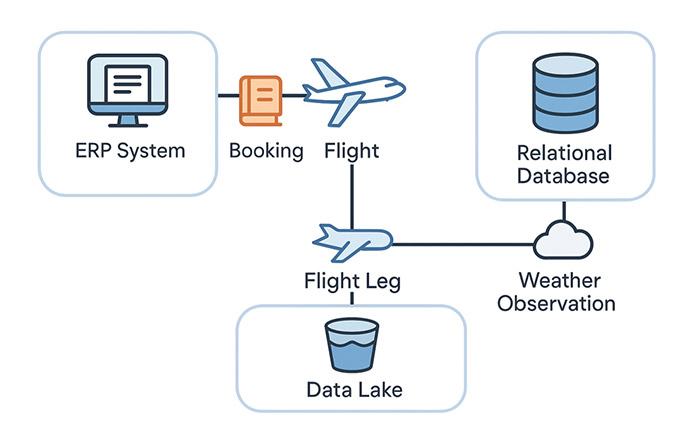
Booking, flight and weather data connected across source systems.
One knowledge model, two customer experiences
The Web-based Model Builder lets modeling teams shape the Semantic Layer and Ontology. The SemantX Knowledge Portal gives end users access to the resulting connected knowledge.
01 WHY IT WAS CREATED
Remove technical barriers
02 WEB-BASED MODEL BUILDER
Shape the Semantic Layer and Ontology
03 SEMANTX KNOWLEDGE PORTAL
Give end users intuitive access
Customer self-service
Governed semantics
Clear roles
End-user adoption
Case studies
SemantX and the Knowledge Graph Agent, at work in three industries
Generative AI can hallucinate and doesn't know your private data. The Knowledge Graph Agent uses ontology-guided retrieval (Graph-RAG) to pull validated facts from SemantX before it answers. Each model below is built on the same foundation.
Connect clinical and patient data for faster, safer decisions
Study data, experimental data and patient data usually live apart. SemantX links them in one semantic layer, enriched with trusted public references.
Model the drug development semantic layer
Every entity and relationship is defined once: patients, projects, studies, trial arms and elements, drugs, targets, pathogens, biomarkers, vital signs, visits, time points and SDTM parameters. The whole team gets one view with every entity connected.
Talk to your data
Ask a question in plain language. The Knowledge Graph Agent compares candidates attribute by attribute and returns the linked evidence behind its answer.
Which antibodies in my repository are similar to adalimumab?
Knowledge-engine-based analytics
The knowledge engine carries answers straight into downstream analysis, so teams apply AI and agentic solutions with confidence, faster.
Single source of truth
A central metadata hub for every study.
Harmonized analytics
Interconnected data ready for advanced analysis.
Data to reporting
Seamless flow through ADaM model integration.
A federated flight and cargo model on IATA ONE Record
Virtual integration. Data from the data lake, relational databases and APIs is integrated without centralizing or duplicating it.
A shared semantic model. IATA ONE Record describes flights, legs, weather, cargo and assets the same way everywhere.
One object-centric view. A unified graph over every system, while each system remains the authoritative source.
Consistent meaning. Controlled vocabularies and linked identifiers align heterogeneous data.
HCAT: a hydrocracking catalysis ontology
A domain ontology for hydrocracking catalysis and process context, designed for hydrocracking, biofuels and retrieval-oriented knowledge organization. It is built for patents, technical literature and retrieval workflows, with OBO-style IDs and multilingual, OCR-tolerant synonyms.
Read the ontology in detail
Design choices
- Retrieval-first
- Classes and synonyms are chosen to improve tagging of patents, process descriptions and OCR text.
- Evidence-driven growth
- Corpus term reports and expert review drive new classes, synonyms and refinements.
- Conservative semantics
- Logical relations are added where they help understanding, without asserting more than the evidence supports.
- BFO-aligned backbone
- BFO provides the top level; HCAT adds domain mid-level classes such as portion of material and process stream.
- Practical deliverables
- The same ontology supports OWL release, tagging dictionaries, term reports, prompt schema and QA.
Key relationship patterns
| Process | uses feedstock | Stream |
| Process | produces product | Fraction |
| Process | operates in reactor | Equipment |
| Process | has operating condition | Quality |
| Process | has performance metric | Quality |
| Catalyst | has active metal | Metal component |
| Catalyst | has support material | Material |
| Stream | has component | Material |
BFO top-level categories: Process, Material entity, Quality, Portion of material.
Topics covered
- Processes
- Hydrocracking, hydrotreating, hydroisomerization, dewaxing
- Catalysts and functions
- Hydrocracking catalyst, acid function, hydrogenation function, NiMo / CoMo / NiW
- Materials and zeolites
- Alumina, silica-alumina, Y / USY / Beta / ZSM, pore classes
- Streams and fractions
- VGO, DAO, wax oil, tail oil, recycle oil, hydrogen-rich gas
- Equipment and unit ops
- Reactors, separators, compressors, fractionation columns
- Conditions and metrics
- Temperature, pressure, H₂/oil ratio, LHSV, yield, selectivity, viscosity index
- Biofuels context
- Renewable feeds, deoxygenation, water tolerance, co-processing
- Main use cases
- Document tagging, retrieval, gap analysis, ontology QA, prompt schema
How the ontology is built
- 1Source corpusPatents, abstracts, OCR text, translated full text
- 2Normalize textSectioning, language handling, phrase cleanup
- 3Tag and reportDictionaries, term reports, gap candidates
- 4Expert reviewChemistry validation and hierarchy refinement
- 5Expand ontologyClasses, synonyms, object properties, multilingual variants
- 6QA and reasoningBFO alignment, reasoner checks, consistency fixes
- 7Release assetsOWL, dictionaries, reports, guide, presentation artifacts
Putting knowledge to work
Data fabric
A 360° view without moving
data
CRM, ServiceNow and SAP stay where they are. The graph links them as a connective layer, giving a real-time view of a customer, product or asset.
Search and discovery
Find answers, not documentsdata
The graph knows Jaguar the brand from jaguar the animal, so a search for sustainable packaging also finds documents that say green wrapping.
Governance and lineage
Trust your numbers
Trace every KPI back through each
transformation to its source field, for instant auditability under GDPR and BCBS 239.
Test Head Desc
Test Head
Trace every KPI back through each
transformation to its source field, for instant auditability under GDPR and BCBS 239.